
WIP: The Work Integrity Protocol for Art
The Work Integrity Protocol (WIP) is an evaluation tool for the structured assessment of an artwork’s integrity. It complements the traditional condition report and expands it by incorporating an examination of a work’s truthfulness, identity, coherence, and meaningfulness.

While a condition report describes only the physical state of the object, the Work Integrity Protocol (WIP) asks to what extent an artwork still corresponds today to what it essentially is, in terms of its nature, its artistic intention and its historical reality.
The assessment is not absolute, but always conducted in comparison with a “hypothetical reference artwork of similar type and quality under optimal museum care conditions.”
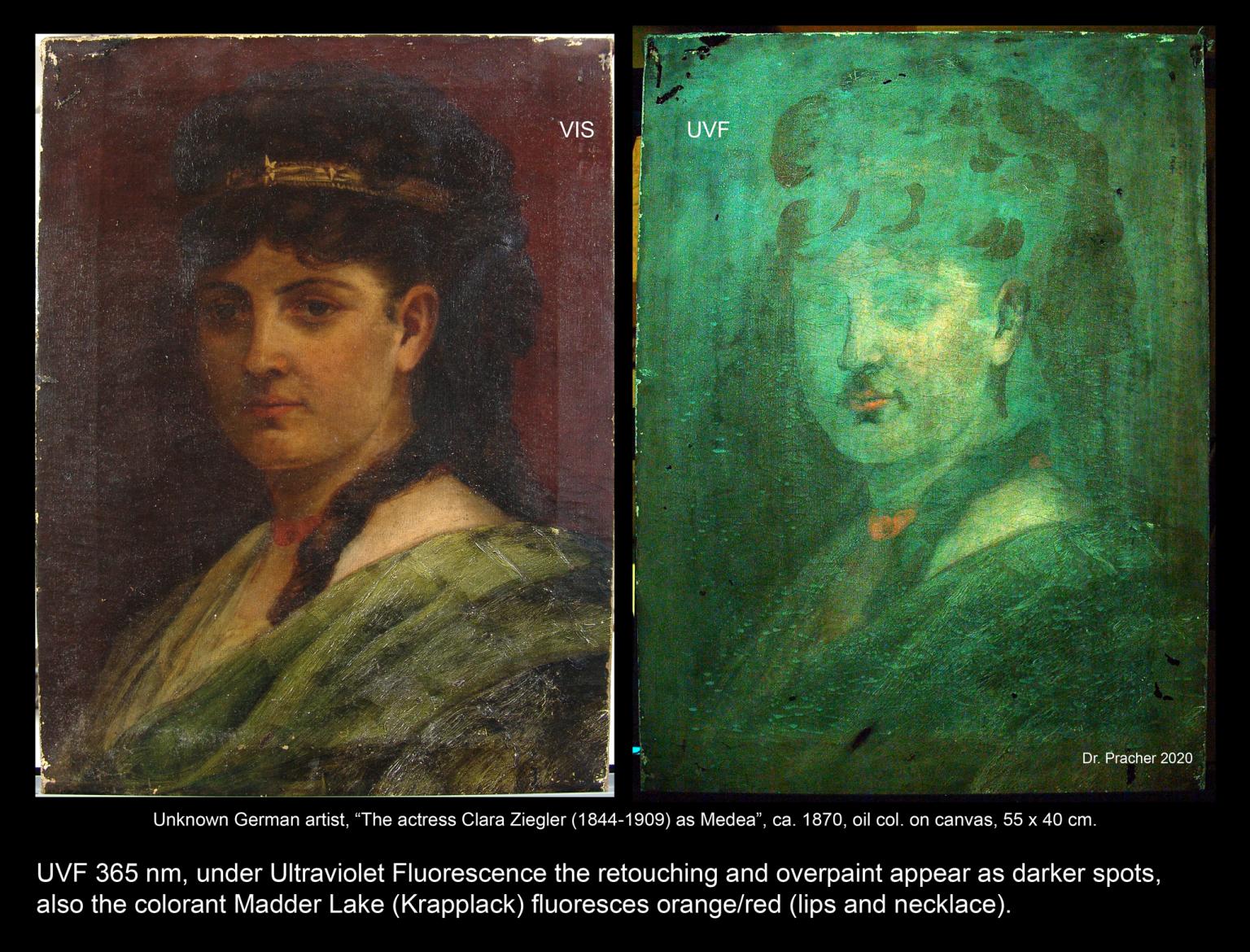
In visible light, the painting appears largely intact. Under UV fluorescence, extensive retouching becomes evident. How much of the artist’s original concept remains? How significantly do the retouches alter the understanding of the painting? How high is the artwork’s integrity compared to a hypothetical similar portrait under the best museum care? The Integrity Protocol provides answers to these questions.
The Concept of the Artwork’s Integrity
The integrity refers to the degree of coherence, consistency and expressive power of an artwork as a whole. The concept is based on the UNESCO definition of integrity as the measure of completeness and meaningfulness of cultural heritage, adapted here to apply to individual artworks.
The Artwork’s integrity is therefore a comparative quality measure that does not exclude historical change, but evaluates it in relation to a comparable reference work.
Authenticity and Integrity – Two Distinct Concepts
Authenticity denotes the genuineness of a work of art. It answers the question of whether the work was truly created by the named artist or craftsman and whether its authorship is secure. Establishing authenticity is the foundation of every art historical and expert evaluation.
Integrity, on the other hand, describes the degree to which a work remains a coherent, unified whole in terms of material, form, meaning and impact.
A piece can be completely authentic yet have low integrity—for example, if restorations, overpaintings or losses have significantly compromised the work’s original expression.
Evaluation Mechanism
The work’s integrity is assessed using defined material and immaterial criteria on a scale from 1.00 to 10.00, the WIP Score. It’s basically a simplification to define the artwork’s integrity at a certain point of time. For each criterion, the artwork under review is compared with a “hypothetical reference work of similar type and quality under best museum care.” The degree of integrity still present in each aspect is explained and justified.
Experienced experts, loss adjusters, art historians, and conservators can project hypothetical best states. In the insurance field—for decades—this has been implemented through the difference hypothesis, while conservators strive toward well-maintained optimal conditions with minimal interventions.
By assessing integrity as a measurable unit, different works of art can now be compared with one another. This makes it a useful decision-making tool.
Material Criteria of Artwork’s Integrity
- M1 – Material Integrity
- To what extent does the existing physical material correspond to that of a comparable reference work?
- M2 – Technical Integrity
- To what extent does the visible and verifiable art technique correspond to the original technical conception and execution of a comparable work?
- M3 – Formal Integrity
- To what extent do form, surface, color and overall effect correspond to the appearance of a comparable reference work?
- M4 – Historic Material and Age-related Traces
- To what extent are the existing aging and use traces historically plausible and compatible with those of a comparable work?
Immaterial Criteria of Artwork’s Integrity
- I1 – Artistic Intention
- To what extent does the work still visibly reflect the original artistic intention?
- I2 – Meaning and Expressive Coherence
- To what extent does the work convey its content-related, cultural, and symbolic meaning without distortion compared to a reference work?
- I3 – Contextual Integrity
- To what extent does the current presentation and use context support an appropriate and truthful perception of the work?
- I4 – Historical Integrity
- To what extent does the present condition correspond to the documented historical reality of the work?
- I5 – Perceptual and Experiential Integrity
- To what extent does the work still allow a coherent aesthetic and intellectual experience comparable to that of a reference work?
Fields of Application
The Wok Integrity Protocol “WIP) is used for:
- Purchase and sale decisions in the art and auction market
It clarifies how close the work remains to the artist’s original concept. An authentic work with high integrity is a compelling buying argument. - Insurance evaluations and damage cases
Damage worsens a work’s integrity. A conservation / restoration can improve the integrity. Evaluation based on integrity—not damage alone—leads to more honest and comprehensible results. - Assessment of the diminution of value
The “diminution of value after restoration” can be argued more precisely. Also since conservation and restoration can enhance the integrity, the former general assumption of an automatic diminution of value after conservation / restoration is challenged. - Strategic collection analysis
When assessing, insuring, and curating collections, the Work Integrity Protocol (WIP) can reveal a collection’s actual significance and uniqueness—far beyond authenticity alone. - Conservation decision-making
With the goal of increasing integrity—not merely stabilizing condition and improving readability—conservation and restoration strategies can be formulated and justified more clearly.
The use of the artwork’s integrity as a measurable unit enables a transparent evaluation that goes beyond physical condition and differentiates the degree of proximity to an artwork’s ideal state.
Dr. Martin Pracher, January 2026
Related article =>
What is the integrity of a work of art?
Paradigm shift: From damage assessment to integrity assessment

